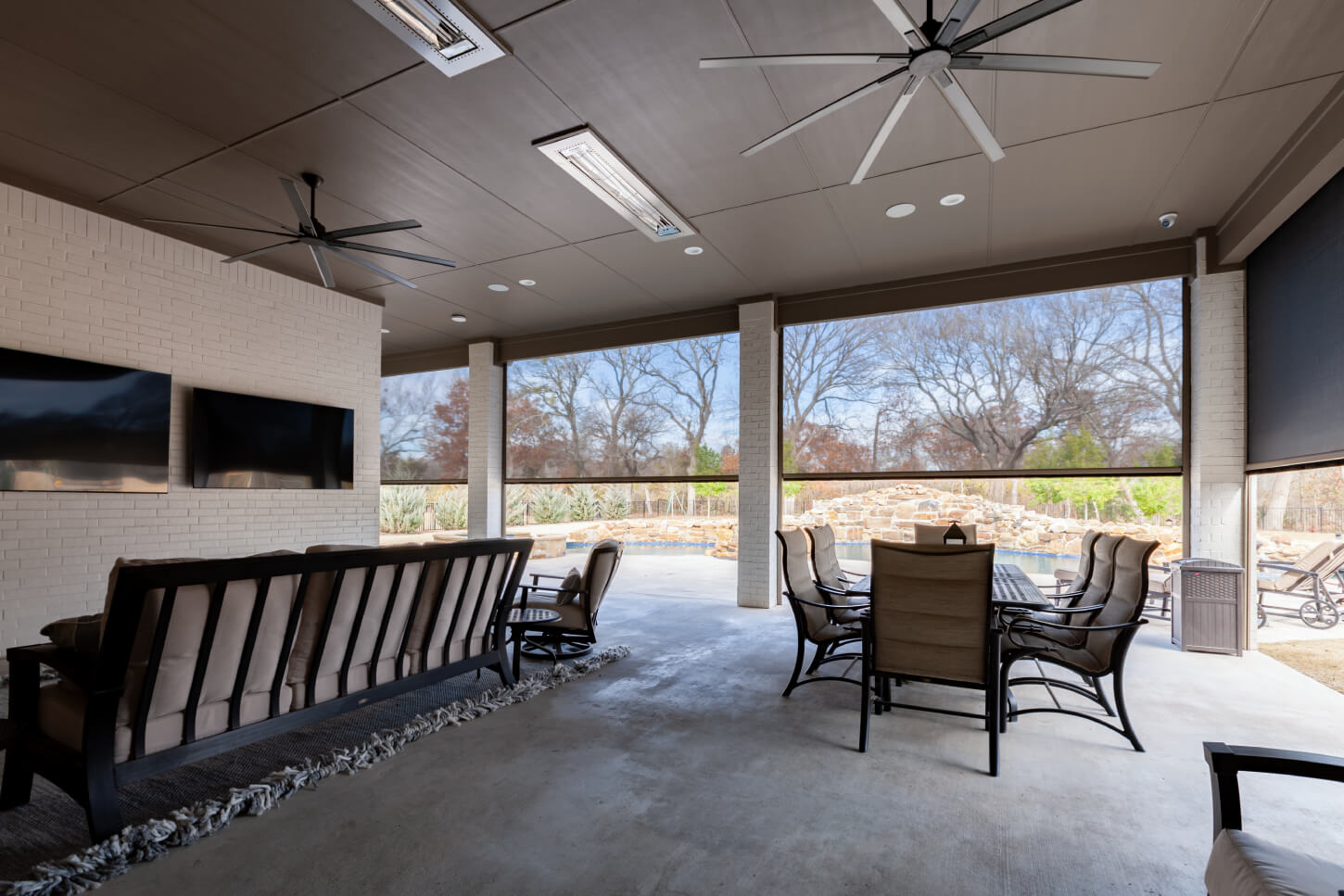
The best way to combine rolling shutters and solar screens is to match each product to the opening and the problem you are trying to solve. Solar screens are designed to reduce solar heat, glare, UV exposure, and daytime visibility while maintaining some outward visibility. Rolling shutters provide a stronger physical barrier for security, privacy, severe weather, and room darkening.
Using both products does not mean every window needs to look different. Custom solar screens and rolling shutters can be coordinated by color, finish, housing, frames, and mounting details. That makes it possible to use solar screens across large windows and patios while using rolling shutters on doors, bedrooms, or other openings where additional protection is important.
For DFW homeowners, that combination can address several problems at once. One room may be baking from afternoon sun while another needs total privacy at night. A patio may need glare reduction and insect protection, while a vulnerable window may need security and storm protection.
Blinds Brothers installs custom exterior solar screens and rolling shutters throughout Dallas-Fort Worth, with each system measured and configured for the opening rather than relying on a one-size-fits-all product.
Solar screens and rolling shutters are both installed on the exterior, but they approach the problem differently.
Blinds Brothers' solar screen systems use woven screen mesh that travels within an aluminum housing and rail system. When shade is needed, the screen lowers across the opening. When it is not, the fabric can roll back into the housing.
Rolling shutters use interlocking aluminum slats that roll into a compact box mounted above the window or door frame. When closed, they create a more substantial physical barrier across the opening.
That difference affects what each product is best suited for. Solar screens focus heavily on sun control, glare, UV protection, visibility, and daytime privacy. Rolling shutters add security, storm protection, total privacy, room darkening, and additional insulation.
The two products can therefore work together rather than compete with one another.
For many DFW homeowners, heat is the reason they start looking at exterior shading.
Direct sunlight hitting a window transfers solar energy toward the glass. Once that energy reaches the window, some of it contributes to heat gain inside the room.
Solar screens place the screen mesh outside the glass.
Instead of waiting until the sun's heat has already entered the room, the exterior screen intercepts some of that solar radiation earlier in the process. This can reduce heat gain through heavily exposed windows.
That can be especially useful for:
Some solar screen fabrics are designed to block approximately 80% to 90% of the sun's heat. The actual result depends on the fabric, openness, window orientation, surrounding shade, and amount of direct sunlight.
This is where custom solar screens can make a difference. Instead of treating every opening in the house the same way, you can focus stronger solar control where the sun creates the biggest problem.
Not every opening needs the same level of coverage.
A living room with a large west-facing window may primarily need relief from heat and glare. A bedroom may need complete privacy and room darkening. A vulnerable door may need additional security and protection during severe weather.
Rolling shutters are suited to those situations.
Constructed from interlocking heavy-duty aluminum slats, rolling shutters create a rigid exterior barrier when closed. They can help protect windows and doors from hail and flying debris while also adding security and privacy.
They can be particularly useful for:
Rolling shutters can also improve indoor comfort by limiting sunlight, reducing outside ambient noise, and creating an insulating barrier against colder temperatures.
The result is different from a solar screen. A solar screen filters the sun while maintaining some visibility. A closed rolling shutter can provide near-total room darkening and visual privacy.
Combining the two products can help address heat across different parts of the house.
Solar screens are particularly useful for windows that receive hours of direct sun. By blocking some solar radiation before it reaches the glass, they can reduce one source of heat entering the home.
Rolling shutters can provide even more substantial blocking when closed.
That can affect the amount of cooling required to maintain comfortable indoor temperatures.
However, neither product should be treated as a guarantee of a specific reduction in cooling costs. Energy consumption depends on far more than exterior shading.
Factors include:
Reducing solar heat can still make sense for homeowners trying to reduce air conditioning workload, particularly when large windows receive strong afternoon sunlight.
Using two exterior products does not mean your house needs to look pieced together.
The key is coordinating the systems during the design process.
Solar screens use fabric that is available in different colors and openness levels. Rolling shutters are available in a range of colors and profiles. Housing, frames, rails, and other hardware can also be considered as part of the overall exterior.
That allows the systems to work with:
A solar screen may disappear visually into one part of the house while a rolling shutter provides a stronger architectural element elsewhere.
The products do not have to be identical. They simply need to look intentional.
Custom installation also helps because each system is built around the exact measurements and mounting conditions of the opening rather than forcing a standard width or length into the space.
Heat is not the only problem caused by strong afternoon sun.
Direct sunlight can create glare across:
Solar screens can reduce glare by filtering sunlight before it reaches the glass.
This can be especially useful in a home office where the sun makes a computer screen difficult to see or in a living room where afternoon glare makes it harder to watch television.
Solar screens can also reduce exposure to harmful UV rays.
Repeated UV exposure can contribute to fading in:
The level of UV protection depends on the screen fabric. Some solar insect screens are designed to filter approximately 65% of UV rays and heat, while other fabrics provide different levels of protection.
Rolling shutters can provide another level of protection when fully closed, particularly when homeowners want to block sunlight entirely during certain periods.
There is an easy way to see what prolonged sun exposure can do.
Look at the flooring directly beside a large window. Compare it with an area that receives less sunlight. Check furniture that sits in front of the glass. Look closely at rugs, artwork, and fabrics that have been exposed for years.
The difference can be surprisingly obvious.
Exterior solar screens help reduce that daily exposure by filtering sunlight before it enters through the glass. Rolling shutters can go further when closed by creating a much stronger barrier against direct sunlight.
Neither product completely eliminates the possibility of fading. But reducing exposure can help protect flooring, furniture, and other furnishings over time.
For homeowners who have invested in expensive wood, furniture, rugs, or artwork, that protection can be an important part of the decision.
Privacy does not always have to mean closing the house off completely.
Solar screens provide a different approach.
During the day, the screen mesh can make it more difficult for people outside to see into the home while allowing people inside to maintain outward visibility.
That can be useful for:
The level of daytime privacy depends on fabric openness, fabric color, and lighting conditions.
Rolling shutters provide a different level of privacy. When fully closed, they can provide total visual privacy and substantial room darkening.
This makes them particularly suited to bedrooms, doors, and other spaces where complete privacy matters more than maintaining a view.
One of the biggest concerns homeowners have about exterior shading is losing the view.
They want relief from the sun, but they do not want the living room, patio, or pool area to feel closed off.
Solar screen fabric is designed to balance shade and visibility.
A more open screen can allow more natural light, airflow, and outward visibility. A tighter fabric can provide stronger shade, glare reduction, daytime privacy, and UV protection.
Openness factors vary by fabric and product, with solar screens available across a range of options.
That means the right fabric depends on the space.
A west-facing bedroom may benefit from a tighter screen than a covered patio overlooking a pool. A room with intense television glare may need different screen mesh than a patio where visibility and ventilation are the bigger priorities.
Rolling shutters are different because their operation gives you a more dramatic choice between open and closed.
The goal is not simply blocking as much sunlight as possible. It is controlling the amount of heat, light, privacy, and visibility you want at each opening.
A covered patio can still become nearly unusable during a North Texas afternoon.
The roof blocks overhead sunlight, but it does not necessarily stop low-angle sunlight entering from the side.
Exterior solar screens can close that gap.
When lowered, they can provide:
When the weather improves, the screens can roll back into their housing and restore the open-air feel.
For homeowners who have invested in patios, pergolas, pools, or outdoor kitchens but avoid using them until the sun goes down, exterior screens can make the space more practical throughout the day.
Rolling shutters can also be used for appropriate exterior openings when security, severe-weather protection, or greater privacy is part of the goal.
Blinds Brothers' exterior shading systems are designed for outdoor living applications throughout Dallas-Fort Worth.
Solar screens and insect screens are not interchangeable.
Traditional insect screens are primarily designed to keep bugs out while allowing airflow. Solar screens use purpose-built fabric to manage solar heat, glare, UV exposure, privacy, and visibility.
Some applications call for one benefit more than another.
A tighter solar screen may prioritize heat reduction and privacy. A more open screen or insect-focused fabric can prioritize ventilation and bug protection.
Blinds Brothers offers a Tuff Insect Screen for homeowners whose primary concern is insects.
That distinction is useful when planning a whole-house project. The screen that works best across a sunny living room may not be the screen that makes the most sense around an outdoor seating area.
Function usually comes first, but appearance still matters.
A custom solar screen is designed around the actual opening rather than simply selecting an off-the-shelf product that happens to be close to the right size.
The same principle applies to rolling shutters.
Custom systems account for:
Some installations may require specific hardware, including brick clips or casement clips, depending on the structure and mounting conditions.
That attention to detail helps the finished installation look intentional instead of added as an afterthought.
The biggest difference is where the product interacts with the sun.
An interior blind operates after sunlight has already reached the window glass. An exterior solar screen sits outside the glass and can intercept some solar radiation before it reaches the window.
That makes exterior screens particularly useful when heat and glare are major concerns.
Rolling shutters take the concept further by creating a physical exterior barrier when closed. They can control light, privacy, security, and weather exposure in addition to solar heat.
Interior blinds can still be useful for certain applications, but Blinds Brothers specializes in exterior solar screens and rolling shutters rather than interior residential blinds, shades, or curtains.
Solar screens are not all made from the same fabric.
The screen mesh determines much of the balance between solar heat control, glare reduction, UV protection, privacy, airflow, and outward visibility.
One of the most important characteristics is fabric openness.
A tighter weave generally provides:
A more open weave generally provides:
Fabric color can influence the appearance of the screen and how glare and visibility are perceived.
That is why choosing the right solar screen should be based on the opening and how the space is used rather than selecting one fabric for the entire house.
Different openings call for different solutions.
These are often good candidates for solar screens because afternoon sunlight reaches them during some of the hottest hours of the day.
These openings can also experience substantial direct sun and heat later in the afternoon.
Large areas of glass provide more surface area for sunlight to enter. Solar screens can help manage heat and glare while preserving some outward visibility.
Large glass doors can contribute significant heat and glare depending on their orientation. Exterior solar screens provide shade without permanently covering the opening.
Rolling shutters can make sense when complete privacy and room darkening are more important than maintaining an open view.
Exterior solar screens can reduce sunlight entering from the sides of a covered space while allowing the screens to roll open when conditions are comfortable.
Rolling shutters may be better suited to openings where security, severe-weather protection, and a rigid physical barrier are priorities.
The benefits of exterior shading depend partly on using the products at the right time.
That can become inconvenient when a house has multiple windows, doors, patios, and other openings.
Motorization solves much of that problem.
Blinds Brothers' motorized exterior screens can be paired with compatible home automation for easier control. Rolling shutters can also be operated manually or through compatible motorized controls, depending on the system.
A homeowner might have solar screens lower automatically when afternoon sun reaches the west side of the house. Rolling shutters can remain open during the day and close when privacy or storm protection is needed.
Compatible smart-home systems can also provide smartphone and voice control through platforms such as Alexa, Google Home, and Apple HomeKit.
The result is a shading system that works more consistently without requiring someone to walk around the house adjusting every screen and shutter.
Not necessarily.
A shaded north-facing window may receive relatively little direct solar heat. A large west-facing window may receive hours of intense afternoon sun.
Those two openings should not automatically receive the same product.
The smarter approach is to evaluate the house opening by opening.
Consider:
That helps determine where solar screens provide the greatest value and where rolling shutters make more sense.
The goal is not to cover every opening with the most expensive product. It is to build a system around the problems you actually have.
Commercial buildings can experience many of the same problems as homes, often across larger areas of glass.
Offices may need to reduce glare across monitors and workspaces. Restaurants can use exterior screens around patio seating. Retail locations may need to manage sunlight reaching storefront glass and displays.
Commercial properties may also have openings where security, privacy, or weather protection are higher priorities.
Blinds Brothers provides commercial window treatments, commercial exterior screens, shutters, and motorized treatments for businesses throughout Dallas-Fort Worth.
The same basic principle applies to commercial projects: identify what each opening needs and select the system accordingly.
Exterior products deal with the weather every day.
Dust, pollen, wind, rain, insects, and debris can accumulate around solar screen fabric, housings, rails, shutters, and other hardware.
Basic maintenance can help preserve both appearance and operation.
Watch for:
Problems identified early may be easier to address than damage discovered after a system stops operating correctly.
For motorized systems, unusual operation is also a reason to have the system inspected rather than continuing to force the screen or shutter.
The right product matters, but so do the measurements, installation, materials, controls, and support behind it. Blinds Brothers has served Dallas-Fort Worth for more than 25 years as a local, family-owned company specializing in custom exterior solar screens and rolling shutters.
Every project starts with the property itself. The team measures the openings, considers sun exposure and how each space is used, and helps determine where solar screens or rolling shutters make the most sense. Fabric openness, color, hardware, operation, and motorization can all be considered as part of the design.
Professional installation then brings those pieces together. The goal is a system that fits the opening properly and operates the way it should.
Blinds Brothers also provides:
Warranty coverage is also available on qualifying products and installations, with specific terms depending on the product.
For homeowners comparing DIY solar screen kits, assembled screens, or standard retail products, the difference is the complete project. A professional installation accounts for exact measurements, mounting conditions, hardware, operation, and the way the finished system fits the property.
A cohesive exterior shading system does not require every opening to use the same product.
Solar screens can handle the windows and patios where heat, glare, UV exposure, and daytime privacy are the biggest concerns. Rolling shutters can handle openings where security, storm protection, complete privacy, and room darkening matter more.
The two systems can still work together visually.
Coordinated colors, finishes, frames, housings, and professional installation can help create a consistent exterior appearance while allowing each opening to perform a different job.
For homeowners dealing with Texas heat, intense afternoon sun, glare, fading furniture, or concerns about severe storms, that combination can provide more control over the house without closing it off from the outside.
Blinds Brothers specializes in custom exterior solar screens and rolling shutters for homes and businesses throughout Dallas-Fort Worth. Contact Blinds Brothers to schedule a free estimate and discuss which openings would benefit most from each system.
Yes. Combining the two can make sense when different openings have different needs. Solar screens are generally suited to heat control, glare reduction, UV protection, daytime privacy, and visibility. Rolling shutters provide additional security, storm protection, privacy, and room darkening.
Solar screens use fabric or screen mesh to filter sunlight while maintaining some visibility. Rolling shutters use interlocking aluminum slats to create a rigid barrier when closed. Shutters are therefore better suited to applications where security, privacy, weather protection, or blackout are major priorities.
Yes. Closed rolling shutters can significantly limit solar radiation reaching the window and can create an additional insulating barrier. Some systems are marketed as stopping up to 99% of radiant heat, but actual performance depends on the specific shutter, window, installation, and conditions.
Rolling shutters provide a rigid physical barrier over suitable windows and doors and can help protect the glass from hail and flying debris during severe storms. Specific protection depends on the shutter system and its tested specifications.
Yes. Blinds Brothers offers motorized rolling shutters, with compatible systems capable of smartphone and smart-home control. Operation options depend on the specific system selected.
They can reduce one source of cooling demand by limiting solar heat entering through exposed windows. Actual cooling costs depend on the house, windows, insulation, HVAC system, weather, fabric, and other conditions.
Performance varies by fabric. Some solar screen fabrics are designed to block approximately 80% to 90% of the sun's heat. The exact specification should be tied to the specific screen material and installation.
Solar screen fabrics can provide substantial UV protection, but the exact amount varies by material. Some solar insect screens are designed to filter approximately 65% of UV rays and heat. Specific product specifications should be used when evaluating the actual protection.
No. Insect screens are primarily designed to keep insects out while allowing airflow. Solar screens are designed to manage heat, glare, UV rays, privacy, and visibility. Blinds Brothers also offers a Tuff Insect Screen for applications where insect protection is the main priority.
DIY solar screen kits are available from retail websites and can work for some simple applications. However, custom systems are better suited to openings that require exact measurements, custom sizes, specialized hardware, corners, large doors, or motorization.
The width and length of the opening determine how the screen, frames, rails, housing, and hardware need to be configured. Accurate measurements help create a proper fit and ensure the screen can operate correctly.
Yes. Solar screens can make it more difficult to see inside during daylight while allowing people inside to maintain outward visibility. The effect depends on fabric openness, color, lighting conditions, and the surrounding environment.
When closed, rolling shutters can provide total visual privacy and substantial room darkening. This makes them useful for bedrooms, private spaces, and openings where nighttime privacy is important.
Yes. The systems can be coordinated through exterior colors, finishes, frames, housings, and other installation details. Matching those elements during the design process can create a more cohesive appearance across the house.
Yes. Exterior solar screens can be installed on suitable doors, patios, and other outdoor openings. The system needs to be selected according to the opening's exact measurements, mounting conditions, and intended operation.
Rolling shutters can help reduce outside ambient noise by adding another barrier between the interior and exterior. Some systems are marketed with significant sound reduction, but actual performance varies according to the shutter, window, building construction, and other conditions.
Not necessarily. Windows differ in orientation, size, shade, and how much direct sunlight they receive. A large west-facing window may benefit much more than a naturally shaded opening. Evaluating each space individually helps determine where exterior shading will make the biggest difference.
.webp)